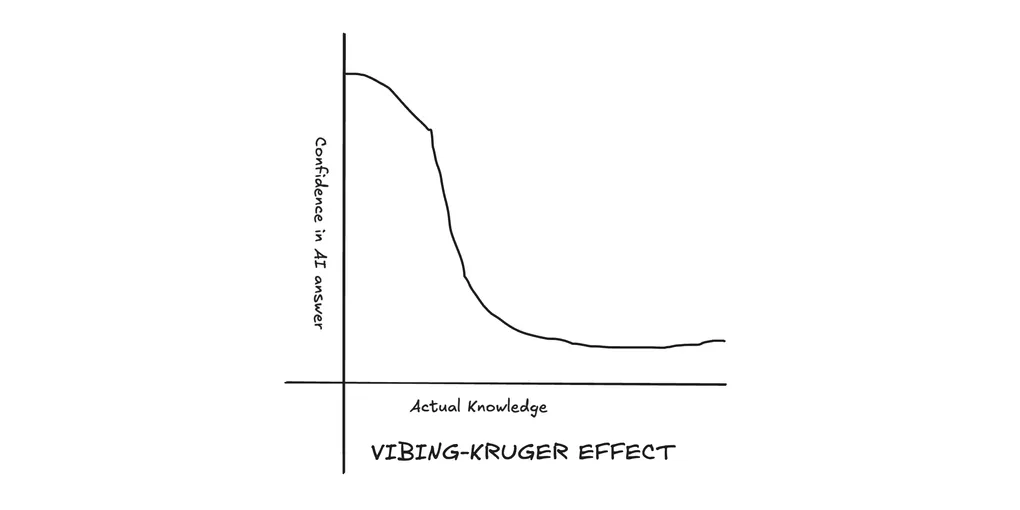
The Vibing-Kruger Effect
In 1995, a man robbed banks after smearing lemon juice on his face, since he thought it would make him invisible. When he was caught, he responded, “But I wore the juice!” This became known as the Dunning-Kruger Effect.
“But I used Opus!” (or Fable, or Astra)
This is the Vibing-Kruger Effect. We think we understand something at an expert level, and don’t dig deep enough to know that the AI is sycophantically leading us down a garden path.
I’m a Principal Engineer, I’ve built systems in dozens of programming languages over decades of experience, and I still sometimes drink the Kool-Aid the AI hands me. Let alone what happens with less cynical builders: I’ve seen 80-page documents that the author has not bothered to read, code repos that contain test after test with hard-coded passing results, and people who are sure they’ve solved some of the great programming problems of their era.
The core loop that works for me, and that I follow both at work and in my personal projects, is:
- ALIGN: until you and the AI have no questions and seem to be in agreement, keep asking questions of the AI, reading its proposal, and make sure you fully understand the plan.
- TEST-BUILD: Get the AI to build the first attempt, with lots of test code.
- TEAR-DOWN: Now ask a new AI, the best one you can find, to do a deep adversarial review of what just got built. Use a new AI, and even a different model family if possible.
- AMEND: Get the first AI to correct any bugs or problems it finds (keep doing tear-down/amend a few times, until it stops finding issues).
- CHECK: Try it out yourself, and make sure it’s what you wanted.
- KONMARI: Now ask the AI to clean up, refactor and DRY the code to make it simpler and more consistent, Marie-Kondo style. AIs like to duplicate code and this keeps your codebase manageable and simple.
And then I do the loop all over again on the next feature.
Where have you seen the Vibing-Kruger Effect, and how do you avoid it?